You are currently viewing How to Implement Oracle Audit Vault Database Firewall (AVDF)

How to Implement Oracle Audit Vault Database Firewall (AVDF)

A Path to Enhancing the Database Security

In this post, we’re deep diving into the Oracle Audit Vault and Database Firewall (AVDF) which helps in enhancing the Database Security and Auditing requirements for the Organizations.

  • Organizations today, have hundreds of databases, apps, and several operating systems where user and administrator activity must be audited and monitored from security and compliance point of view. This requires constant collection and analysis of massive amount of activity data to run reports and generate alerts on anomalous activities. 
  • Monitoring database activity to support incident investigation, detect potentially malicious behavior, and fulfill regulatory requirements is essential.

Oracle AVDF

Oracle Audit Vault and Database Firewall (AVDF) is a comprehensive database security solution that combines Database Activity Monitoring (DAM) with Database Security Posture Management (DSPM) to protect both Oracle and non-Oracle databases, whether deployed on-premises or in the cloud.

It collects and consolidates audit data from databases, operating systems, and directories, while also monitoring SQL traffic in real time to detect and block unauthorized access. AVDF supports hundreds of targets, including Oracle DB, MySQL, Microsoft SQL Server, PostgreSQL, IBM Db2, and more.

What AVDF can do ?

  • Database Activity Monitoring (DAM): Tracks SQL statements, privileged user actions, and suspicious patterns to detect threats.
  • Database Security Posture Management (DSPM): Assesses database configurations, user entitlements, and sensitive data exposure to identify risks.
  • SQL Firewall: Logs or blocks SQL injection attempts and enforces trusted application access.
  • Compliance Reporting: Provides out-of-the-box reports, report data can be easily filtered, searched for investigations and provide needed reports to auditors. 
  • Forensic Analysis: Transaction Log collection from redo logs provides before and after values for DML and captures DDL changes for investigation.


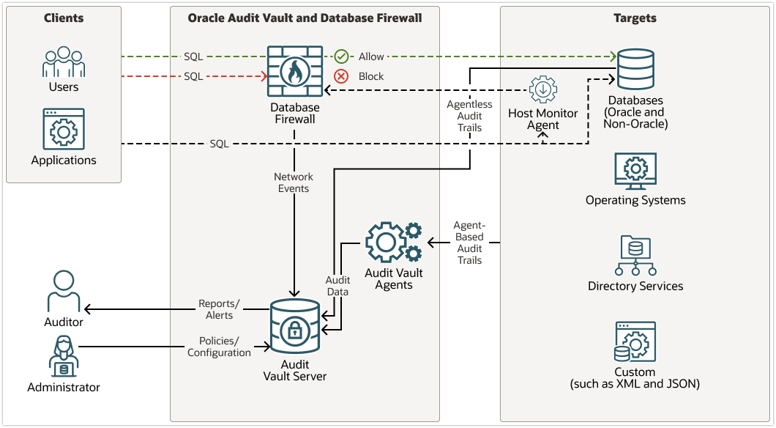
Oracle AVDF Architecture

avdf_architecture

Architecture Highlights

  • Audit Vault Server: Central repository for audit data, policies, and alerts.
  • Database Firewall: Monitors SQL traffic and enforces security rules.
  • Audit Vault Agent / Host Monitor Agent: Collects audit data from targets; supports both agent-based and agentless collection.
  • High Availability: Supports primary-standby configurations for both Audit Vault Server and Database Firewall.


AVDF in Action

  • Sources: Oracle DB, EBS DB, OS, directory services, custom XML/JSON, SQL traffic.
  • Collectors: Audit Vault Agent, agentless collection, Host Monitor, Transaction Log collector.
  • Control plane: Audit Vault Server manages policies, trails, users, alerts, archive, and reporting.
  • Protection: Database Firewall inspects SQL traffic and can log, alert, substitute, or block.
 

Business Use Cases

  • Compliance reporting: Use built-in and custom reporting over centralized audit data for regulations, internal controls, and periodic audits.
  • User activity tracing: Track who changed what, when, and from where across database and network activity streams.
  • Before/after analysis: Use transaction log collection to analyze DML before and after values and DDL operations from redo-based capture.
  • SQL attack prevention: Database Firewall can detect deviations and block unauthorized SQL, including SQL injection patterns.
  • Policy-driven monitoring: Apply firewall and audit policies to enforce trusted paths and generate alerts on violations.
  • Large target estates: Scale to hundreds or thousands of targets using central management and standardized collection patterns.

Key Business Benefits

  1. Blocks unauthorized SQL traffic from the reach of database.
  2. Addresses compliance initiatives quickly with pre-packaged and customizable reports.
  3. Reduces cost of ownership with a secure appliance form factor.
  4. Lowers security risks by auditing and monitoring database activity across enterprise database.
  5. Provides visibility into system use and activity tracking on-premise and cloud system across the hybrid data center.
  6. Decreases the operational costs of compliance with governance and regulatory policies.
  7. Manages data risks by detecting and blocking attempts to compromise data in application databases.
  8. Provides enterprise-level scalability, security, automation and extensibility.

To Be Continued. . .

In next post, we’ll be diving into the Implementation Architecture, Data Flow, Sizing & Topology, Hands-on Installation and Configurations, etc.,